


Redraw
A redraw is the extra improvement equity a made hand carries to a stronger hand on later streets. It is why a flopped set on a flushy board still wants action.
Practice this in Poker Skill. The Polarized Continuation Bets lesson bets a made hand with a redraw on the flop, a pair of aces with a queen kicker plus the nut flush draw, for value now with strong chances to improve.
Get the free appRedraw: when a made hand still has outs to improve
What a redraw means in No-Limit Hold’em
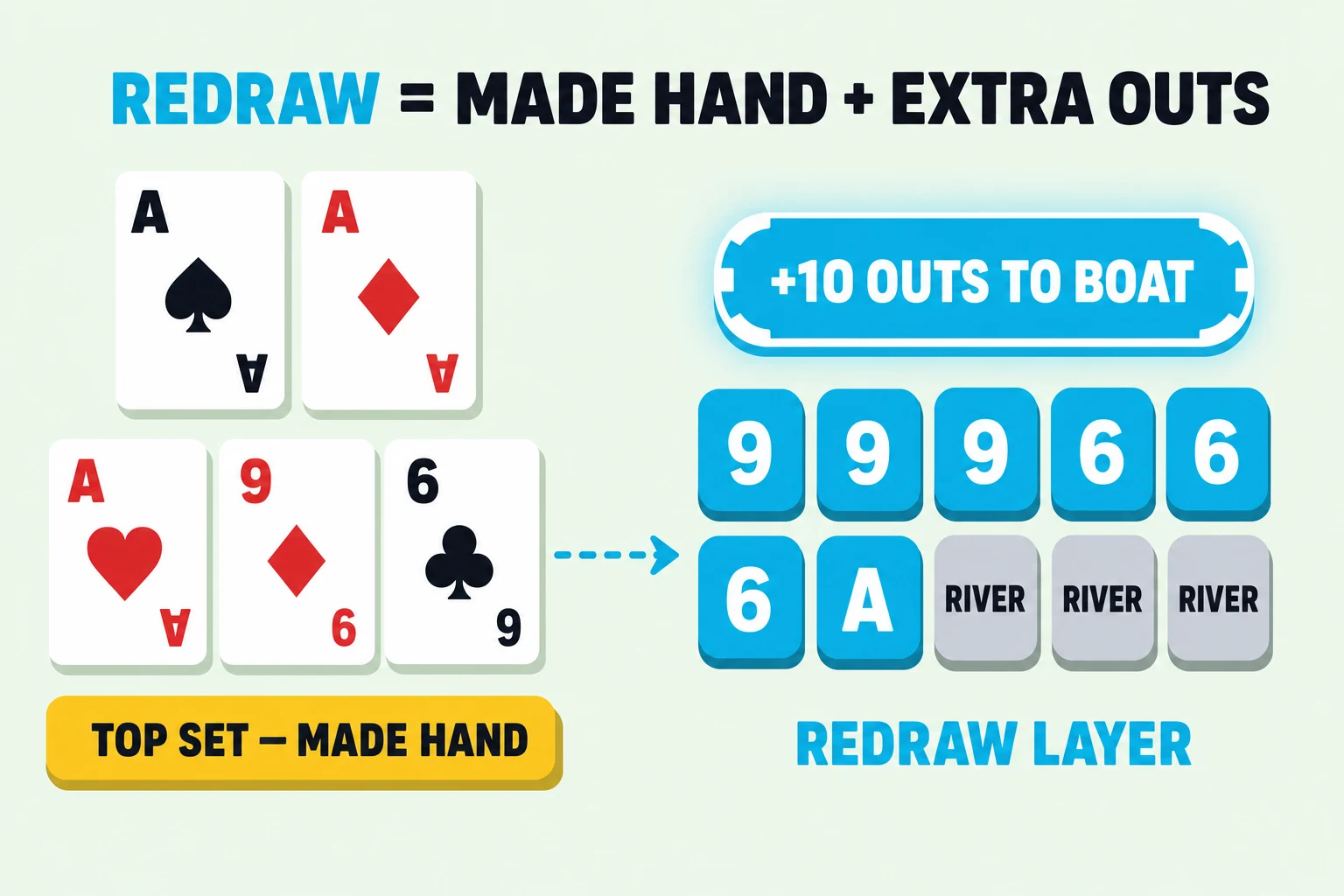
Redraw is the extra improvement equity a made hand carries to a stronger hand on later streets. You are already ahead, and the next card or two can promote your hand even further. The canonical shape is a flopped set on a flush-draw board: your set is the made hand, and the board-pairing cards give you a redraw to a full house if a flush completes against you.
A useful mental shortcut:
- Made hand + extra outs = redraw equity layered on top of the lead.
- Made hand + no extra outs = a naked made hand. Same showdown value, far more vulnerable to scary turns and rivers.
- Made hand + redraw is what keeps you comfortable continuing against aggression. The redraw is your insurance if your opponent has a primary draw and hits it.
Related terms
Redraw vs. nut draw vs. backdoor draw
A redraw is not the same shape as a primary draw, even though the out-counting math overlaps.
| Hand state | Lead now? | Outs to improve? | Where it earns money |
|---|---|---|---|
| Naked made hand | Yes | No | Showdown if it holds |
| Made hand with redraw | Yes | Yes | Showdown plus extra value when the redraw hits |
| Nut draw | No | Yes, to the nuts | Implied odds when the draw comes in |
| Backdoor draw | No | Runner-runner only | Adds thin equity to bluffs and turn barrels |
The scoreboard difference is who has the lead. A primary draw needs to hit to win. A redraw protects a hand that is already winning.
When redraws matter most
Redraws change your decision more on some boards than others.
- Wet, two-tone or connected boards. This is where opponents’ primary draws are common and your made hand needs backup to be comfortable getting stacks in. See wet board.
- Heads-up, deep stacks. Both players can bet and call on multiple streets. The redraw is what lets you call or three-bet a turn aggression line without folding into your own equity.
- Versus draw-heavy ranges. When your opponent’s calling range is built around flush and straight draws, every street that completes a draw is a street you need a redraw to survive.
- Facing a flop or turn raise. This is the clearest decision the redraw influences. Top set on a wet board can call or jam over a raise with the redraw layer behind it. Without that redraw, the same flop often slows down.
Where redraws matter less:
- Dry, static boards. Top set on K-7-2 rainbow has all the equity it needs. The board-pair outs are barely doing work because no live draw threatens the lead.
- Multiway pots. Fold equity drops, ranges tighten, and someone usually has the nuts on the runout that completes a draw. Redraws still exist, but the bet-call-call line gets thinner.
- Short-stack lines. If money is going in on the flop regardless, the redraw layer rarely changes the decision. Your equity versus range is already priced in.
Example: top set with the board-pair redraw
You raise pre-flop in the cutoff with A♠A♦. The big blind calls.
Flop: A♥ 9♦ 6♣. You have top set, the strongest possible made hand here. You bet around 50 to 60% pot to charge the calling range and fold out hands with no equity.
Turn: J♦. A second diamond. Diamond flush draws are now live. If your opponent has K♦Q♦ or T♦8♦, they have 9 outs to a flush by the river.
This is where the redraw earns its keep. You still have:
- 1 case ace (quads).
- 3 nines and 3 sixes (full house).
- 3 board-pair outs added when the river falls.
That is 7 outs at this moment, with another 3 board-pair outs added when the river itself falls. Against a flush draw, you are roughly 78 to 80% to either hold up to a clean river or fill up to a full house if the flush hits. Against a worse made hand, you are a heavier favorite and the redraw mostly does not matter.
The redraw is what lets you bet again on the turn for value, call a turn raise without folding into your own equity, and price in a stack-off if the river is a blank.
Example: top pair plus the nut flush redraw
You open the button with A♠K♠. The big blind calls.
Flop: A♥ 9♠ 7♠. You have top pair top kicker, a made hand. You also hold the nut flush draw with two spades on the board.
The redraw layer here is the 9 spades that complete the nut flush. Pair-up cards (3 kings to two pair, 2 case aces to trips) add a few more clean outs, but the headline equity is the flush.
Against a worse Ax (AJ, AT, AQ without a spade) you are well ahead now, and the flush redraw is gravy. Against a set (99 or 77), you are behind, but you have 9 outs to a flush and the redraw makes you correct to continue against most lines short of a check-raise jam.
The strategic effect: you are happy to bet, happy to call a raise, and willing to stack off on flushy turns. The same hand without the spade redraw, A♥K♣ on the same flop, folds to a flop check-raise far more often. Same top pair, very different willingness to play a big pot.
Common mistakes
1) Counting the redraw outs as if they are all equal
A flush card that pairs the board does not improve a flopped set the same way as a clean board-pair card. A king that gives you two pair is fine against air but worthless against a set that has you crushed. A clean redraw count subtracts the outs that simultaneously give your opponent a stronger hand. The classic version of this mistake is calling a straight draw plus flush draw 17 outs when it is really 15 because two cards complete both draws.
2) Forgetting the opponent’s redraw against you
If you flop a flush and your opponent has a set, your flush is ahead now but the board-pair outs are their redraw to a full house. The asymmetry runs both ways. Recognize when you are the made hand without a redraw and the opponent has one.
3) Treating a redraw as a license to slow-play
A redraw is insurance, not a green light to check the flop. Slow-playing top set on a flushy flop saves a small number of bets when the board runs out blank and costs the entire pot the times the flush comes in and you did not charge for it.
4) Stacking off on the same texture without the redraw
If you would call all-in with top set plus a board-pair redraw on a wet flop, do not assume the same line is right with top two pair. Two pair has fewer redraw outs (only the four pair-up cards to a boat), and the equity gap shows up exactly when the flush completes.
FAQ
Is a redraw the same as a backdoor draw?
No. A backdoor draw is a runner-runner secondary draw on a hand that is not yet made. A redraw is the extra improvement equity on a hand that is already made. The two concepts share the “secondary equity” framing but apply at different points in the hand.
How many outs does a typical redraw have?
It depends on the made hand. A flopped set has roughly 7 outs to improve on the flop, plus another 3 board-pair outs once the turn lands. Top pair plus a nut flush draw has the 9 flush outs plus a few pair-up outs. The number is not the point; the point is that there is a clear layer of equity on top of the made hand.
Does a redraw change my bet size?
Often, yes. With a redraw, you can size up to charge an opponent’s primary draw without worrying as much about getting blown off your hand. Without a redraw, the same wet board pushes you toward smaller sizing, more pot control, and more willingness to fold to aggression.