


Mixed Games
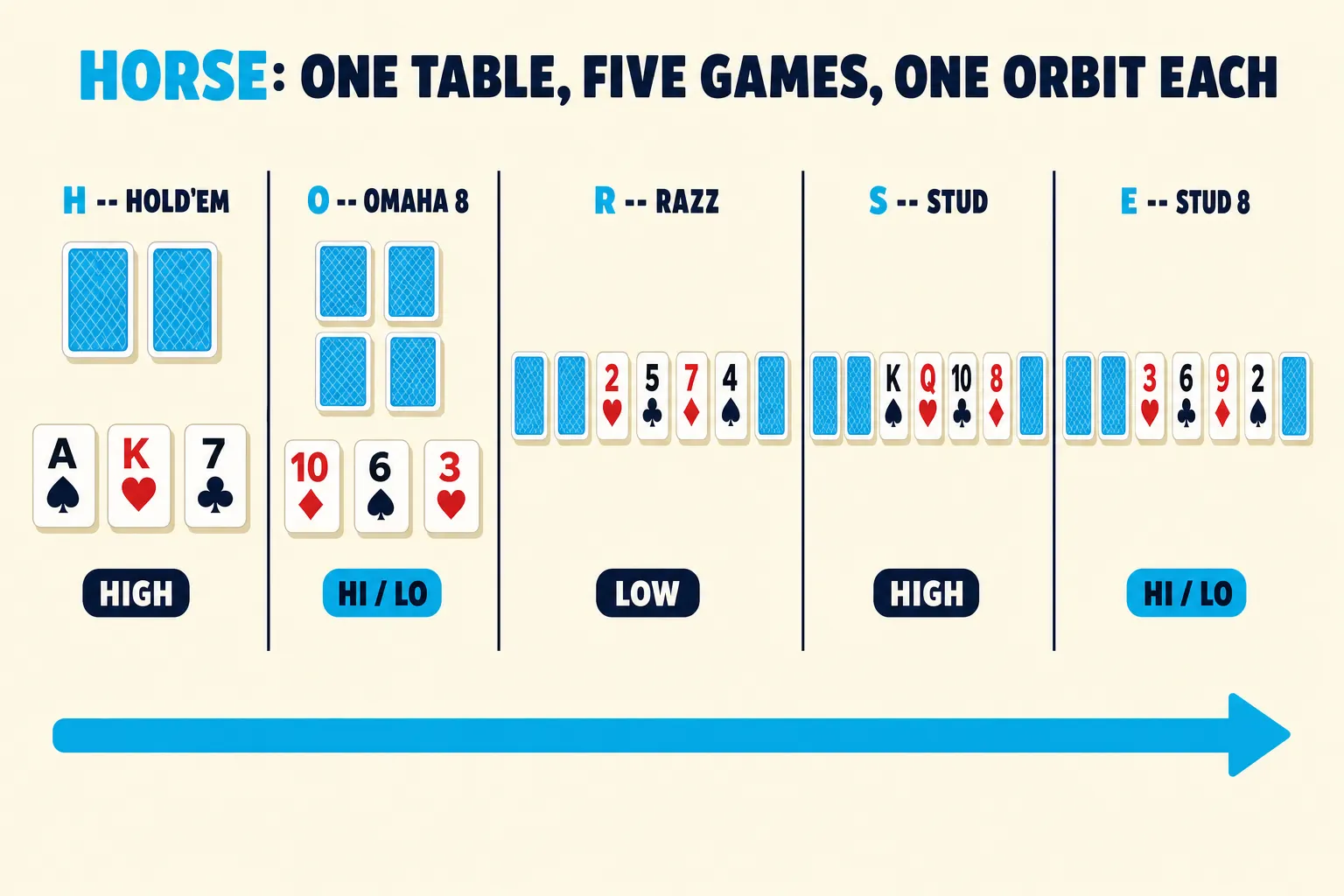
Mixed games are poker formats that rotate among several variants on a fixed schedule, like HORSE or 8-game. The same table plays a few hands of one game, then switches.
Mixed Games: poker formats that rotate among multiple variants
Definition: a rotating-variant poker format
Mixed games are poker formats where the same table plays several variants on a fixed schedule rather than staying on one game the whole session. The dealer (or the software) calls the active variant; the table plays an agreed number of hands or an agreed length of time; and the rotation moves to the next variant in the lineup. The most common live mix is HORSE, five fixed-limit games rotated in order. Larger spreads add no-limit and pot-limit variants and run six, seven, eight, or nine games deep. The format exists because top-level poker rooms long ago wanted a single seat that tested players across the whole game family, not just the one they grew up on. The five-game version has its own guide: how to play HORSE walks through the rotation and all five games in it. For the wider picture, mixed games, formats, and how to learn each one covers 8-game and dealer’s choice as well, and links the page that teaches every variant in the lineup.
The common rotations: HORSE, 8-game, 9-game
Most mixed-game seats fall into one of three lineups. The variants differ; the rotation idea does not.
| Mix | Games inside | Betting | Where it shows up |
|---|---|---|---|
| HORSE | Hold’em, Omaha 8-or-better, Razz, Seven-Card Stud, Stud 8-or-better | Fixed-limit across the board | Live cash mid- and high-stakes; WSOP $10K and $50K HORSE events |
| 8-game | Limit 2-7 triple draw, limit Hold’em, limit Omaha 8, limit Razz, limit Stud, limit Stud 8, no-limit Hold’em, pot-limit Omaha | Mix of limit, no-limit, pot-limit | Online mixed cash; WSOP $50,000 Players Championship; high-stakes home games |
| 9-game / 10-game | 8-game lineup plus badugi, 2-7 single draw, sometimes badeucy or badacey | Mix | Specialist online cash; high-stakes home games |
HORSE is the entry point because every game in it shares the same betting structure — once you know how to read a fixed-limit pot, the only thing that changes from variant to variant is the hand-ranking direction (high vs. low vs. split) and the deal mechanic (community vs. stud). The 8-game and 9-game spreads add the harder cross-cut: the bet-structure switch (limit to no-limit to pot-limit) lands in the same orbit as the variant switch, so a player has to retune both at once.
When mixed games matter most
Three places mixed-game vocabulary actually pays off for a player who mostly plays no-limit Hold’em.
- High-stakes live cash. The biggest live cash games at Bellagio, ARIA, and similar rooms are dealt as multi-game rotations far more often than as straight no-limit. A no-limit specialist who shows up to a mixed seat without the other games is paying the table the cost of being a seat-filler in four of every five games dealt.
- Bracelet schedules. The WSOP runs HORSE, 8-game, and 10-game events at $1,500 / $10,000 / $50,000 buy-ins every summer. If your tournament goal is a bracelet outside the no-limit Hold’em main event, the mixed-game side of the schedule is where the smaller fields live.
- Study breadth. Players who train across multiple variants tend to think more clearly about the parts of poker that are not Hold’em-specific — pot-odds versus a draw, value-betting on the river against a calling range, showdown value on the last street. Studying mixed games as a hobby is one of the cheapest ways to stop a no-limit-only player’s blind spots from becoming permanent.
Poker Skill teaches only Texas Hold’em, so it can sharpen the Hold’em games in a mix but not the Omaha, stud, razz or draw games that fill the rest of the rotation.
A worked example: one orbit of HORSE
A six-handed live HORSE table starts on the H. Six hands of limit Hold’em are dealt; the dealer-button rotation completes once around the table. The dealer announces “Omaha 8-or-better” and pulls two extra cards into each starting hand. Six hands of Omaha hi-lo are dealt — every showdown splits the pot when a qualifying low hand is made (five unmatched cards, eight or below). The dealer announces “Razz” and switches the deal to seven-card stud mechanics: each player antes; the highest exposed door card brings in (in Razz the bring-in is the highest card because the lowest hand wins); seven cards per player; the best low hand takes the pot, with no qualifier. Six hands of Razz, then six hands of Seven-Card Stud (same deal mechanic, high hand wins), then six hands of Stud 8-or-better (same deal, hi-lo split with the same eight-or-below low qualifier as the Omaha round).
Five orbits, five games, thirty hands. The dealer button has moved exactly five times around the table; the table goes back to Hold’em and the rotation starts over. A player who saw exactly six hands of each game has played thirty hands total and seen no game more than the others — that is the structural fairness the format buys.
Common mixed-game mistakes a Hold’em player makes
- Reading flush draws and straight draws the Hold’em way in Omaha. Omaha and Big O require exactly two hole cards plus exactly three board cards at showdown. A single suited hole card plus three suited board cards is not a flush. Players moving from Hold’em into the O orbit lose a stack the first time they bet a phantom flush they cannot legally make.
- Forgetting the low qualifier in the hi-lo orbits. In Omaha 8-or-better and Stud 8-or-better, half the pot only goes to a low hand if the low is five unmatched cards, eight or below. No qualifying low and the high hand scoops. New mixed-game players over-call with one-card low draws and pay full price for half a pot they cannot reach.
- Bringing the no-limit reflex into the limit orbits. HORSE is fixed-limit. Three-bets do not threaten anyone’s stack; bluffs that work for big sizings in NLHE do not exist when the maximum bet is one big bet. A player who tries to “punish” a wide range with sizing has nothing to size with.
- Misreading the bring-in in Razz. In Seven-Card Stud (high), the lowest door card brings in. In Razz, the highest door card brings in because the lowest hand wins the pot. Players who default to the stud-high rule give up bring-in money and start the hand on the wrong foot.
- Treating “I am best at Hold’em” as a strategy. The format is built to deny exactly that strategy. A mixed seat is profitable if you are at least competent in every variant the spread covers; it is unprofitable if you have one elite game and four weak ones. Books, training sites, and study groups exist for each variant — the work is non-trivial and there is no shortcut around it.
Where mixed games sit in the poker family
Single-variant tables — no-limit Hold’em cash, pot-limit Omaha cash, a $1,500 stud bracelet event — are the format most live and online seats use. Mixed games sit on top of those single-variant tables as the testing ground for breadth. The variants inside a mix are not new; HORSE is just five existing games rotated, 8-game is eight existing games rotated, and larger specialty rotations add more formats on the same schedule. What the format adds is the reset between variants. Every time the dealer announces the next game, every player at the table re-loads which hand strengths matter, which bets are legal, and what a winning hand even looks like. That reset is the whole reason the format exists. It is also why a mixed-game seat reads, more than anything else, as the most honest test live poker has of how complete a player actually is.