


Range Protection
Range protection is the practice of mixing strong hands into every line so opponents cannot overbet your weak-looking checks and calls on later streets.

Practice this in Poker Skill. The Check-Raise lesson mixes its check-raises, raising top two pair and a set along with an eight-six that is open-ended on 9-7-2.
Get the free appRange protection: keeping every line credible
Definition: what range protection is
Range protection is the practice of building lines that still contain strong hands, so opponents cannot exploit any one of your branches. It is a range-level decision, not a hand-level one. When you raise every set on the flop, your check-call line is now pure draws and one-pair hands, and a thinking opponent will overbet your turns until you fold. Range protection is the discipline that keeps every line you take, especially your checking and calling lines, hard to attack.
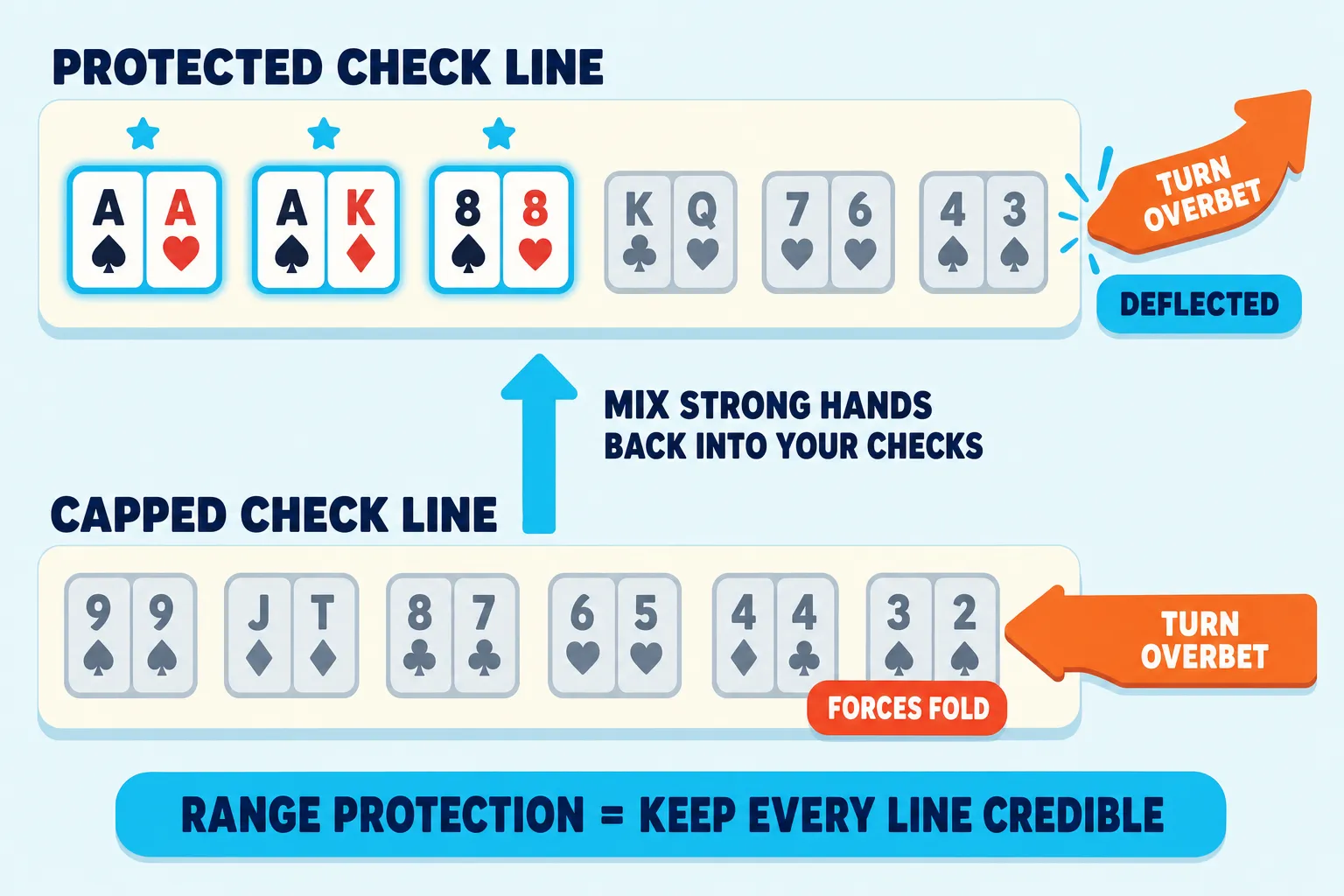
The shortcut for spotting it at the table:
- Strong hands present in the line = the line is protected.
- Strong hands stripped out of the line = the line is capped, and a good opponent will overbet it.
- Hands mixed across multiple lines = the protection mechanism. The mix is what makes the line credible.
Range protection is the decision; a protected range is the result. They describe the same idea from two angles, the way “denying equity” describes an action and “an opponent’s denied equity” describes the outcome.
Related terms
Range protection vs related concepts
These four ideas sit on different axes and get used interchangeably more often than they should.
| Concept | What it answers | Decision level |
|---|---|---|
| Range protection | Does this line still contain credible strong hands? | Across many hands in the same spot |
| Equity denial | Is this one bet charging draws a bad price? | One hand, one street |
| Polarized range | Is this range value plus bluffs with no medium hands? | Shape of one range |
| Range advantage | Does my range have more equity than theirs on this board? | Comparison between two ranges |
Protection is range-level. Equity denial is hand-level. Polarization is range-shape. Range advantage is range-comparison. A single bet can do more than one job at once, but the reasoning behind each job is different, and the decisions diverge often enough to keep them separate in your head.
The most common conflation is range protection with equity denial. They sometimes share an answer (a flop bet can both charge draws and balance the range you took to the turn), but they answer different questions. Equity denial asks what one bet does for one hand. Range protection asks what a thousand decisions in this spot, across all your holdings, do for your line as a whole.
When range protection earns the most
Protection earns the most when stacks are deep enough that a single street can change the size of the pot a lot. In 100bb 6-max cash that is most of the time. The spots where protection carries real weight:
- In position on dry flops where the c-bet decision is close. When a small c-bet does not fold out enough hands and does not get called by enough worse, the in-position raiser checks back. That checking line needs to keep some top pairs and overpairs, or the turn becomes an overbet target.
- Out of position with a wide preflop range. Big-blind defenders who only check-raise their nutted hands leave the rest of the flop check pure-defense. A turn overbet then runs through the whole call-flop, call-turn line.
- On paired or low-card flops where the betting range is narrow. If you only bet trips and overpairs, your checks are face-up as everything else. Mixing some trips back into checks closes that read.
- Against opponents who can attack a capped line. Solid regulars know what your check on the turn is supposed to mean. Recreational players often do not, and against them protection costs you more than it earns.
Protection matters less in spots where there is no future street to defend against:
- Short stacks (under about 30bb effective), where the action will often be all-in by the turn and a future overbet is impossible.
- All-in or near-all-in spots, where no future streets exist.
- River decisions where you cannot be raised, because the punishment that protection prevents is gone.
- Multiway pots against passive opponents who will not punish a capped line even when they could.
Protection costs you frequency you spend somewhere else, so spend it where future overbets can actually punish a capped line.
Example: protecting a flop check-back range
Consider 6-max NLHE cash, 100bb effective. You open A♣K♦ from the button. The big blind calls. The flop comes A♥ 8♣ 2♦ rainbow.
Two ways to play A♥K♣ here:
- Bet always. This treats AK as automatic value and protects nothing. After several thousand hands a thinking opponent notices: when you check this flop, you never have an ace. They start raising your turn checks and floating wide on the flop, because your check range is medium pairs and missed broadways.
- Mix some check-backs into the spot. Maybe you check 30 percent of your A-high hands. Now your checking line carries top pair, second pair, and air. When you check the flop, the big blind cannot lead the turn for two-thirds pot and expect you to fold AK.
The second line is range protection in action. The decision is not “should I slowplay AK.” It is “does my check range need credible top pairs to survive a turn overbet, and if it does, where do those top pairs come from?” The answer is that some of them come from AK on this flop.
A useful read on the spot: against a typical big-blind defending range on A-8-2, AK has range advantage and roughly 75 percent equity. A small c-bet captures real value when called. A check-back loses some of that value but pays for itself by keeping the strong end of your range in the line that gets the most attacked on later streets. How often you mix is a frequency question. Whether you mix at all is the protection question.
Common mistakes
1) Raising every strong hand on the flop
The most expensive version of this leak is raising every set, two pair, and overpair on a wet board. The check-call line then becomes pure draws and one-pair hands. On a brick turn, your check-call is exploitable: the opponent fires a big bet, your range can never raise, and your folding frequency goes up. Mix a few sets into the check-call line and the threat returns.
2) Treating the check-raise as nuts-only
If your turn check-raise contains only straights and sets, opponents will start barreling small and pulling out before you can punish them. A protected check-raise carries some bluffs that block the value combos you cannot have, like second-nut blockers and gutshots with backdoors. The protection is mutual: bluffs protect your value combos, and value combos protect your bluffs.
3) Confusing protection with slowplaying
Slowplaying a hand is one tactic that can support protection. It is not the same goal. A player who slowplays AA every time is not protecting their range; they are running a pattern that leaks once opponents notice. Protection is the mix. Sometimes the strong hand goes into the bet line, sometimes into the check line. The randomization is what makes the line credible.
4) Protecting in spots where it does not matter
A range needs no protection when there are no future streets to defend against. Open-shoves on a 12bb stack do not need protection. River bets you cannot be raised on do not need protection. Spending discipline on protection in those spots wastes frequency you could be using on flop and turn lines where overbets actually loom later.
FAQ
What does it mean to protect your range in poker?
Protecting your range means keeping enough strong hands in each of your lines, especially your checking and calling lines, so an opponent cannot blast that line with overbets and force you off everything. Practically, it usually shows up as occasionally checking a hand strong enough to bet, so your check range stays credible on later streets.
Is range protection the same thing as protecting your hand?
No. Protecting your hand usually means betting one hand to deny opponents cheap draws, which is the equity denial idea applied to a single bet on a single street. Range protection is about the structure of all the hands you could have in a given line, across many similar spots. The two ideas point at the same bet sometimes, but the reasoning is different and the decisions diverge often enough to keep them separate.
When should I stop worrying about range protection?
Skip protection when the action is about to end and when your opponent will not punish a capped line. Short stacks, all-in spots, river decisions where you cannot be raised, and recreational opponents who do not adjust to your patterns all reduce the value of protection toward zero. Protect aggressively in deep, multistreet, in-position pots against thinking opponents; relax it in the spots where future overbets cannot reach you.