


Represent
Representing a hand means betting in a way that claims a specific holding. The line tells the story; the opponent folds when the story is consistent and pays you when it isn't.
Practice this in Poker Skill. The Good Barrel Cards lesson plays a turn ace both ways, firing again when the ace scares the pairs that called and brings you a flush draw, and resting when the same ace lands with nothing behind it.
Get the free appRepresent: betting in a way that claims a specific hand
Definition: what represent means at the table
To represent a hand is to bet, raise, and barrel in a way that tells the opponent you hold a specific kind of holding. You are not announcing the cards. You are selling a hand class through the actions that a holding like that would naturally take. When the story is consistent, the opponent folds the hands that lose to it; when the story breaks, they keep calling and you pay them off.
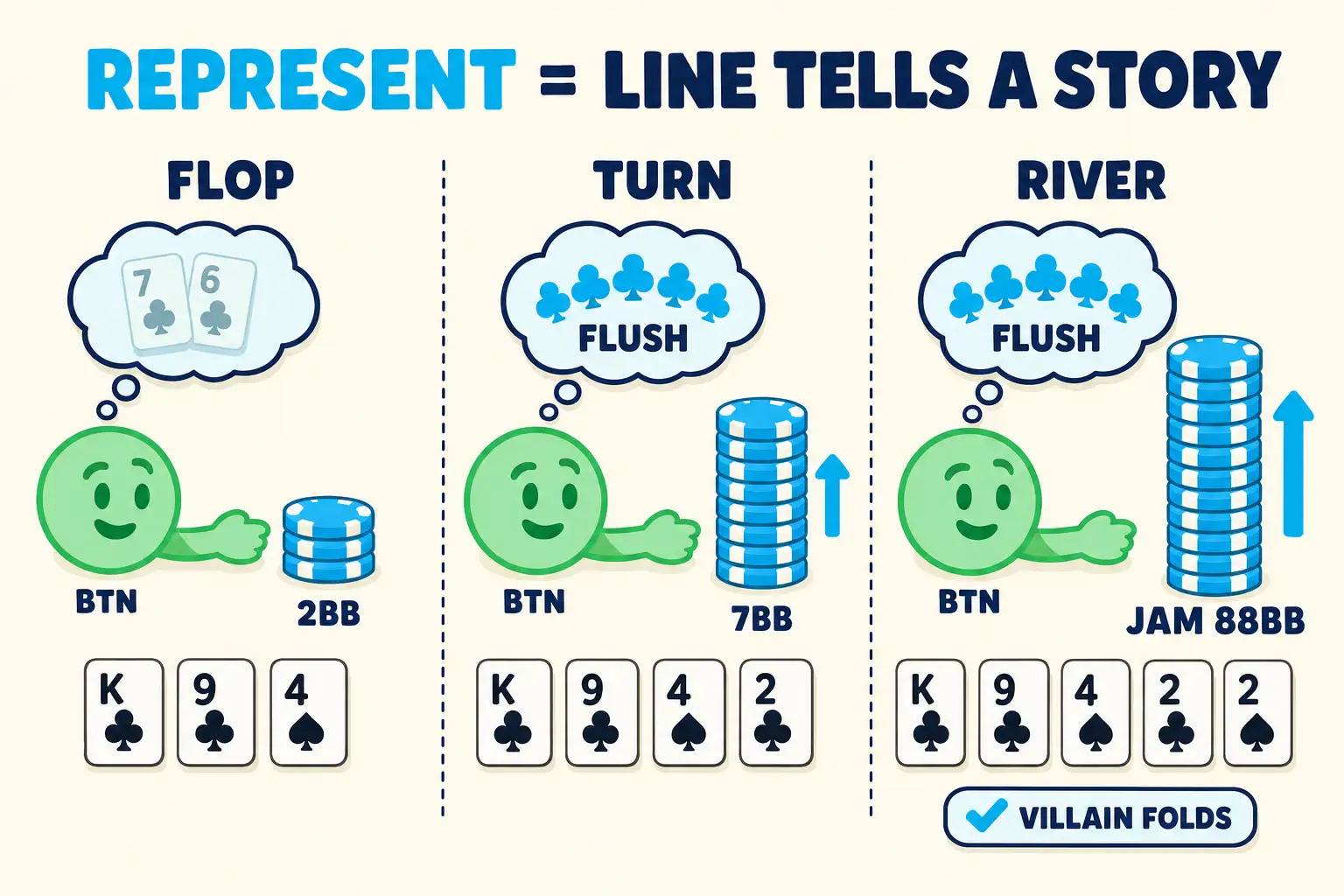
The mechanic is simple. Every action narrows the hand class villain can put you on. Your preflop seat sets the open range, your flop bet sets the strength range that bets that flop, the turn bet eliminates the range that gives up there, and the river bet leaves the smallest range of all. By the river, the hand you are representing is whichever holding remains after every street has filtered the rest.
Mental shortcut
- Representing strength = your line claims you have the value hand on this board.
- Representing a polarized range = your line claims either the value hand or a bluff, and forces villain to commit to a category.
- Representing a capped range = your line claims you do not have the very top, so a check or small bet says you’ve given up on the nuts.
- Representing a draw that bricks = the most common bluff path; the river card has to actually look like the draw.
Related terms
Represent vs. story, bluff, and value bet
The four ideas overlap, but they are not interchangeable.
| Concept | What it is | What you want villain to do |
|---|---|---|
| Represent | The act of using your line to claim a specific hand | Believe the claim |
| Story | The picture across streets that the line paints | Read the picture and respond to it |
| Bluff | A bet with a hand that needs villain to fold | Fold |
| Value bet | A bet from a hand that beats villain’s calling range | Call with worse |
A bluff is one specific use of representing. You can also represent a strong hand with a strong hand (a value bet that looks the same as your bluffs is the whole point of a balanced range). The clean question is not “am I bluffing or value-betting?” but “what hand am I representing, and would the holding I’m claiming take this line?”
When representing a hand pays best
Representation pays best when the story is easy to believe and villain has folds in their range.
- Heads-up pots, where one player needs to fold rather than getting a multiway price.
- Boards that brick draws on the river, where the cards you were supposedly drawing to hit, finally hit.
- Lines that match your perceived range, like a c-bet that fits what a preflop raiser would do, or a turn barrel that fits what the bigger half of your range would do.
- Against opponents who fold, especially tight-aggressive regulars who think in ranges instead of call-everything stations.
- Texture you can credibly own: paired boards, ace-high boards from late position, runouts where one player has more nuts than the other.
It pays much less when:
- The pot is multiway and at least one of the other players has the hand you are repping.
- Villain is a calling station who never folds top pair regardless of how the line looks.
- Your sizing breaks pattern, like half-pot for value and three-quarter-pot for bluffs, which is a tell that gives the line away.
- The runout doesn’t fit, so representing a flush on a board with no flush card on the river is selling fiction.
- You are out of position with no obvious hand class to claim.
Example: representing the flush on a brick-then-flush runout
You open from the button for 2.5bb with 7♠6♠ at 100bb effective. The big blind defends. Pot 5.5bb, stacks 97.5bb behind.
Flop K♣9♣4♠, pot 5.5bb. BB checks. You c-bet 2bb (about 36% pot) representing the wide button range that should bet most of these flops for a small size: strong kings, weak kings, backdoor straight draws, and air. BB calls. Pot 9.5bb.
Turn 2♣, pot 9.5bb. The third club arrives. Now your range contains every flush combo a button opens with: A♣x♣, K♣Q♣, Q♣J♣, J♣T♣, suited clubs down to small ones. You bet 7bb (about 75% pot). BB calls with what looks like a marginal king or a pair-plus-club. Pot 23.5bb.
River 2♠, pot 23.5bb. The board pairs the deuce. No flush hits this exact card, but every club already there is still a flush. You jam for 88.5bb effective. The story you are representing: “I had the flush from the turn and I am betting it.” From villain’s seat, your turn barrel was already polarized to top pairs and flushes, so the river jam removes most of the top-pair value combos because top pair would size down for thin value, leaving flushes and bluffs. With one pair, villain is bluff-catching against a range your line credibly weights toward flushes. They fold KQ, KJ, KT often.
You held 7♠6♠. Air. You won the pot without showdown because the line was the line a flush would take, and the flush was sitting inside your perceived range from preflop forward.
The same hand wins much less if you c-bet 75% on the flop (your sizing telegraphs strength, not the small-bet button range), if the turn is an offsuit brick (the flush you are repping isn’t there), or if villain is a station who calls a jam with second pair.
Common mistakes when representing
1) Repping a hand that isn’t in your range
The biggest miss. A min-raise from UTG can’t credibly represent a small suited connector on the river, because the holding wasn’t in your opening range. If villain knows the range you opened, they know which rivers complete it and which rivers don’t. Pick stories your perceived preflop range actually contains.
2) Sizing tells that give the line away
Using one size for value bets and a different size for bluffs is the fastest way to be read. Same sizing in similar spots is the discipline that keeps both the value and the rep credible. If you only ever overbet rivers when you have it, your overbet rivers stop folding anyone out.
3) Story doesn’t add up across streets
A flop check-call followed by a turn lead and a river jam claims a hand that woke up on the turn for no reason. Thinking opponents will conclude you don’t have it. A consistent story usually means each street’s action is the action that holding would naturally take. Checked-back flop, then leading turn after villain bets small can credibly rep a slow-played strong hand. Checking back the flop and then check-raising the turn cannot.
4) Representing into a calling station
The opponent’s tendency matters more than the line’s beauty. A station who calls down with bottom pair will not fold no matter how clean your representation looks. Save the rep for opponents who actually fold; against the station, value-bet thinner instead.
FAQ
What does it mean to represent a hand in poker?
It means betting and raising in a way that makes a specific kind of holding credible to your opponent. You aren’t announcing your cards. You are taking the actions a hand like that would naturally take, so opponents read you for that hand and respond accordingly. When the line matches, they fold the hands that lose to the represented holding; when it doesn’t, they call and you pay off.
Is representing a hand the same as bluffing?
No, but bluffing is one use of representing. A bluff is betting with a hand that needs villain to fold; representing is the broader act of using your line to claim a specific hand class, which can be a strong value hand or a busted draw. You can also represent a strong hand with a strong hand. That is the whole purpose of a balanced range, where bluffs and value bets take the same line and villain can’t tell them apart.
How do I know if my representation is believable?
Walk through the line as if you were villain. Does the preflop seat reasonably open the hand you are claiming? Does your sizing on each street match the size that hand would use? Does the runout actually contain the cards that hand needs? If any of those answers is no, the rep doesn’t add up and a thinking opponent will start calling. If all of them are yes, the rep is credible and folds will follow against opponents who can fold.