


Spew
Putting chips in without enough EV behind the line. Bets, raises, or calls that ignore position, range, or fold equity, and burn money even when no one drew out on you.
Practice this in Poker Skill. The Hold the Plan lesson drills the cure: deciding on the flop which turn cards keep the bet going, so a second barrel never comes from having fired once.
Get the free appSpew: poker decisions that put chips in without enough EV behind them
What spew is
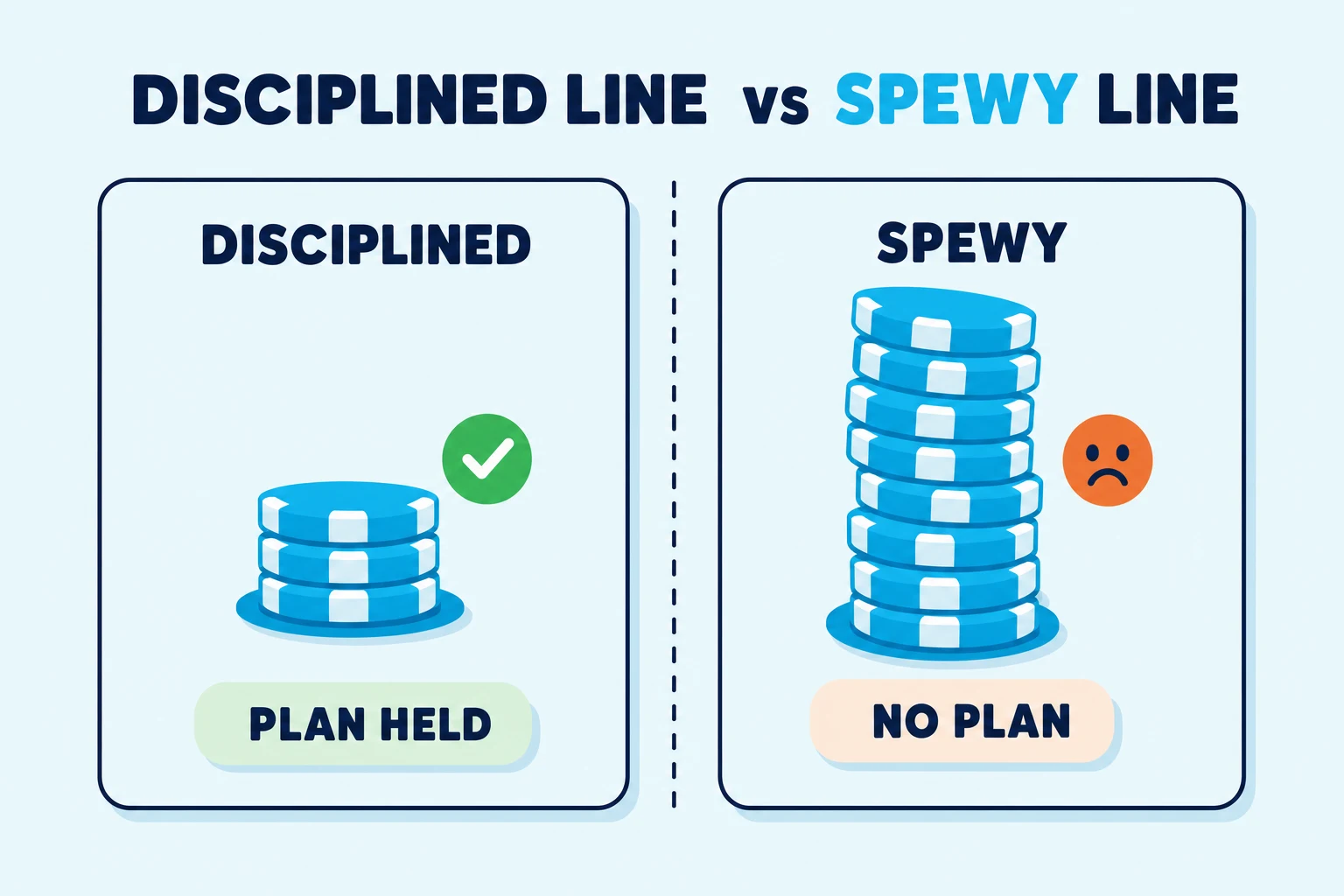
Spew is a label for poker action that looks aggressive or active but does not have enough expected value behind it to justify the chips going in. The classic shapes are a light 3-bet out of position into a range that will not fold, a c-bet plus turn barrel without a real fold-equity story, a call-down with a weak bluff catcher when the line screams value, or any flat that surrenders position and initiative on autopilot. The shared signature is that each street is decided on its own, with no plan from the flop forward.
The recognizable signature is short:
- The action looks aggressive but the line cannot answer “what hands fold here, and what hands call?”
- The motivation is a story about the last hand, not a read on this opponent’s range.
- Strip out the result and the play would still feel wrong on review.
Related terms
Spew vs tilt vs variance
The three terms get used interchangeably at the table. They are not the same. Naming the right one is what separates “I ran bad” from “I have a leak.”
| Frame | What it is | Where the chips went | Fix |
|---|---|---|---|
| Spew | An EV-negative line you would still flag on tomorrow’s review, no matter the result | Into pots where the line ignored position, range, or fold equity | Tighten ranges, plan from the flop, study the spot |
| Tilt | An emotional state that produces spew (and sometimes other leaks) | Into hands you would not have played at baseline | Stop-loss, break, recognize the trigger |
| Variance | The natural spread of a sound strategy’s results over a small sample | Into spots where you got it in good and lost, or got it in bad and were correct to call | Volume; nothing else |
A losing session reflects spew when the losses trace back to repeatable decision errors — wrong frequencies, wrong hands in the range, light c-bets without fold equity, lines taken without a plan for getting raised. A losing session reflects variance when the same lines, played again with a different runout, would have made money.
When spew costs the most
Spew is not equally costly in every spot. The state matters most where decisions are large and where range structure and initiative carry the hand.
Where spew costs the most:
- Light 3-bets out of position into early-position opens — the opener’s range is tight, fold equity is poor, and post-flop is played out of position with a capped range.
- Triple-barrel bluffs that were not planned from the flop. If the flop bet was the only one with a real story, the turn and river chips are the leak.
- Call-downs with a weak bluff catcher when the line is heavy with value combos and the river bet sizing screams polarized.
- Flatting from the small blind on autopilot — surrenders position, caps the range, and lets the big blind play position on you for the rest of the hand.
- Late sessions, deep pots, after a bad beat — the same player, two orbits earlier, would have folded this spot in their sleep.
Where spew costs less:
- Push-fold spots where the math is forced and there is no room to invent a wider line.
- Folding decisions on the early streets — the worst spewy fold is still smaller than a spewy all-in call.
- Hands you are not in. A player who spots the state and sits out two orbits has lost very little to spew that session.
The honest test is one question, asked face-up: would the hand history of this line read as a plan or a series of independent panics?
Example: 100bb 6-max NLHE cash, a spewy triple barrel
100bb effective, $1/$2 6-max NLHE cash. Hero is in the cutoff with A♠T♣. The button is a regular who has folded to roughly 60% of c-bets across the session. The big blind is a sticky caller who has not folded a flop in two hours.
Preflop: Hero opens to $6. Big blind calls. Pot is $13.
Flop: J♥ 8♥ 4♠. The big blind checks. Hero c-bets $9. Big blind calls. Pot is $31.
The flop is fine; a small range bet is reasonable here. But the big blind is the sticky caller. The c-bet’s job was to fold out high cards from a range that does not fold high cards. Already, the chips that went in expected fold equity that the table does not offer.
Turn: 6♣. Hero barrels $22. Big blind calls. Pot is $75.
This is where spew picks up. A♠T♣ has zero fold equity left against a sticky caller’s flop-call range, which is dense in J-x, pocket pairs below the jack, weak flush draws, and 8-x. The barrel is justified on a different opponent. Against this one, it is a chip-donation.
River: 2♣. Hero shoves the remaining $63. Big blind snap-calls with J-9 offsuit.
The leak is not the river. The leak is that the line was decided one street at a time, with no plan from the flop. The player wanted to “make something happen” against a passive opponent and ended up with the worst version of every street.
The non-spew alternative in the same spot: open the same hand, c-bet small as a range bet, give up on the turn when the call narrows the big blind to the part of their range that does not fold. Lose $9 instead of a stack. The river save is bigger than the river bluff would have ever been.
The book line keeps coming back to the same point: if you are not willing to triple-barrel the entire stack from the flop forward, the flop aggression was probably the mistake.
Common mistakes
1) Calling every losing bluff a spew
Not every bluff that gets called is spew. A barrel into an opponent who folds turns at a high rate is a value-of-fold-equity decision; sometimes they wake up with a hand and call. The line was sound, the result went the wrong way. The spew test is not “did it work?” — it is “would the same line, with no information about the result, hold up on review?“
2) Treating spew and tilt as the same thing
Tilt is the emotional state; spew is one of its visible behaviors. The reason to keep the two separate is that the fixes are different. Spew gets fixed with range work, line planning, and study. Tilt gets fixed with stop-losses, breaks, and tilt-control study. A player who treats every spewy session as tilt misses the strategy leak. A player who treats every tilt-driven session as a strategy leak misses the trigger.
3) Mistaking variance for spew on a losing day
A losing session is not automatic evidence of spew. A solid baseline strategy run over a few hundred hands can lose. The cleanest separator is the hand history: if the lines played make sense face-up, the loss is variance and the cure is volume. If the lines played would still flag on review with the cards turned over, the loss is spew and the cure is study.
4) Sizing aggression as the cure for spew
The instinct after a losing stretch is sometimes to bluff bigger or 3-bet wider — to “play more poker.” That is the leak doubling down on itself. The fix for spewy aggression is almost never more aggression; it is fewer hands, tighter spots, and a clearer plan from the flop. Books point at the same anti-spew checklist over and over: shorter session if losing, one game at a time, hand-history review, deliberate tilt control, ranges that respect position and initiative.
FAQ
What does it mean to spew chips in poker?
To spew chips means to put money into the pot through bets, raises, or calls that do not have enough expected value behind them to justify the action. The behavior usually shows up as light 3-bets out of position, multi-street barrels without a plan, or call-downs with hands that the line says are crushed. Spew is the visible behavior; the underlying cause can be tilt, fatigue, or a baseline strategy leak the player has not fixed yet.
Is spew the same as being on tilt?
No. Tilt is the emotional state, spew is one of the behaviors it produces. The same player can spew without tilt — for example, a regular with an unfixed leak in their out-of-position 3-bet range will spew that range every session, win or lose. The same player can also be on tilt without spewing if they recognize the state early and tighten up. Keeping the two apart is what makes session reviews useful.
How do you stop spewing in cash games?
Books point at the same set of habits: tighten the opening ranges, especially out of position; plan multi-street lines from the flop forward instead of one street at a time; review hand histories after a losing session and flag the decisions that would still look wrong with the cards face-up; use a stop-loss to leave when the state of the session is no longer normal; and treat tilt as a separate study area, not a willpower problem. None of those fix every leak overnight, but together they shrink the size of the spew pile faster than playing more hands does.