


5NL
5NL is the $0.02/$0.05 No-Limit Hold'em online cash level, where a 100bb buy-in is $5. It is the second rung of micro stakes, one step above 2NL.

Practice this in Poker Skill. The value-first choices a loose 5NL pool rewards come up in the lessons with no real money attached: in the CO vs One Caller lesson, K♣ Q♣ raises a limper because it beats the weaker kings and queens a limper holds.
Get the free app5NL: $0.02/$0.05 Online No-Limit Hold’em
What 5NL means
5NL is the online cash-game tier where the blinds are $0.02/$0.05 and a full 100 big blind buy-in is $5. The label is a compact form of “5 dollar No-Limit”: the number is the max buy-in in dollars, and “NL” tells you it is No-Limit Hold’em. Cardrooms quote the same game two ways. The blind form, $0.02/$0.05, names the forced bets at the start of every hand. The compact NL form, 5NL, names the buy-in tier. Both point at the same table.
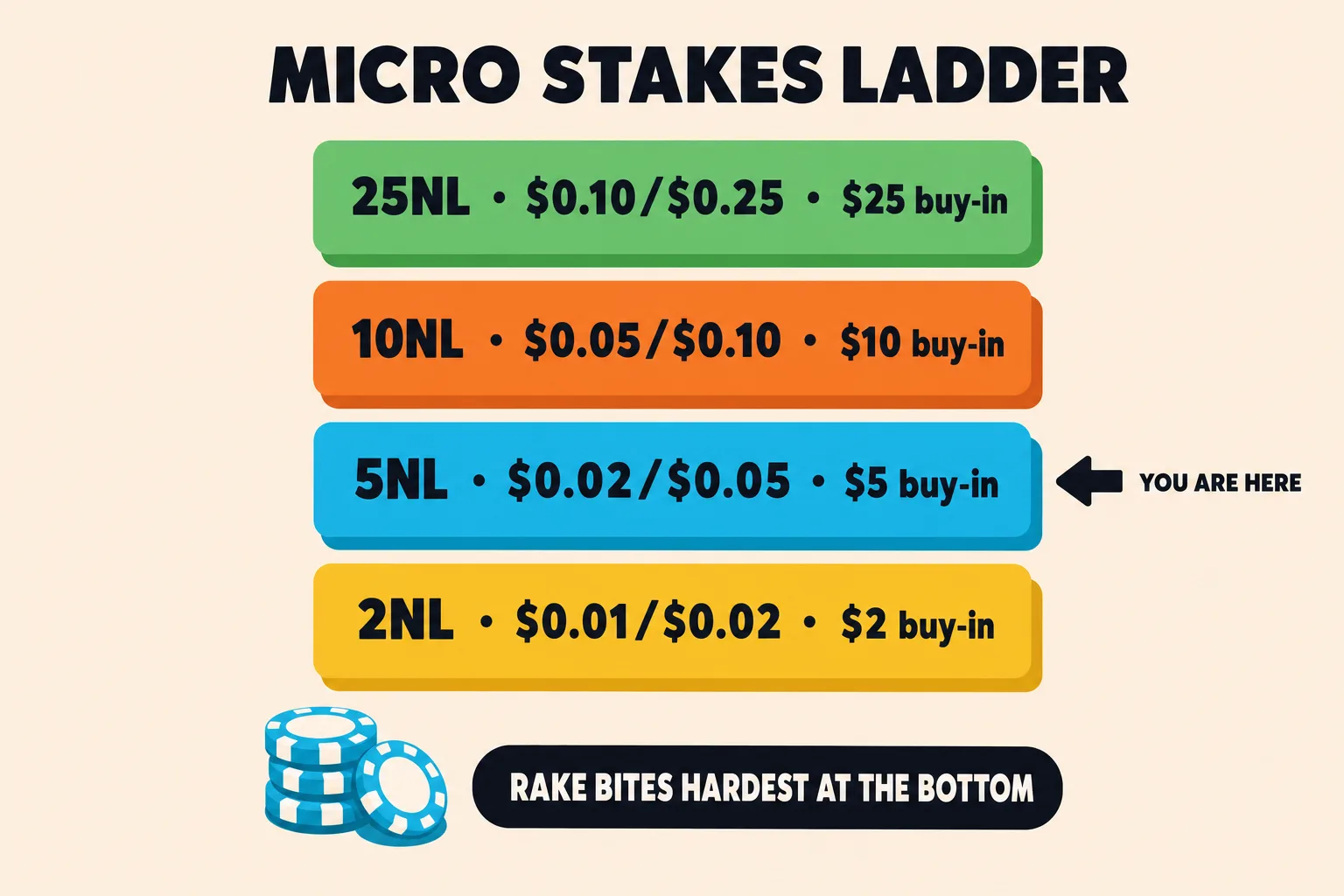
How 5NL fits the micro-stakes ladder
5NL sits inside the micro-stakes tier, one rung above 2NL and one below 10NL. The same naming convention runs all the way up the online cash ladder, with the dollar number tracking the max buy-in at 100 big blinds.
| Label | Blinds | 100bb buy-in |
|---|---|---|
| 2NL | $0.01/$0.02 | $2 |
| 5NL | $0.02/$0.05 | $5 |
| 10NL | $0.05/$0.10 | $10 |
| 25NL | $0.10/$0.25 | $25 |
Live cardrooms almost never use the NL shorthand. They quote stakes by blinds: $1/$2, $2/$5, $5/$10. The NL form is an online convention, which is why 5NL is an online label first.
When 5NL matters most
5NL is a real waypoint, not a generic “low stakes” bucket. The label changes a few decisions even when the strategy looks similar to nearby rungs.
- As the typical move-up from 2NL. Players who start at 2NL and hold a winrate over a real sample usually look at 5NL next. Two and a half times the dollar amount per pot, slightly more attentive opponents, and a rake structure that still bites a meaningful share of pots.
- As a bankroll checkpoint. A $5 buy-in is small enough that variance shows up in hand counts more than dollar swings. Bankroll guidance at 5NL is closer to “play enough hands to see the long run” than “ride out a deep downswing.” Move-down rules matter too: dropping to 2NL when results stall is a feature, not a failure.
- As a rake check. Online rake at micros is typically 5% with a small dollar cap. At a $1 pot the rake is the cap; at a $4 pot it is the percentage. Either way, a meaningful share of every pot you win goes to the room, not your stack.
- As a value-line stress test. The 5NL pool plays loose and sticky. Multi-street bluffs need folds, and folds are scarce at this tier. The first lever you pull is to value-bet more and bluff less, including thin value with second pair when the river is safe.
- As proof you can beat a rake. If you can’t win at 5NL after a real sample, no higher rung will be easier. Higher stakes have a softer rake share, but the pool also tightens and the edge per opponent shrinks. The skill that wins at 5NL is the same skill that scales up.
Example: a 5NL pot
You are sitting in the cutoff at a 6-max 5NL table with a full $5 stack ($0.02/$0.05 blinds). The room takes 5% rake capped at $0.50.
A loose recreational player limps under the gun for $0.05. You raise to $0.20 with K♠Q♠. The big blind calls. The limper calls. Three players take the flop. Pot is $0.62.
Flop K♣9♥4♦. Both blinds and the limper check. You bet $0.40 (about two-thirds of the pot) for value with top pair, second kicker. The big blind calls. The limper folds. Pot is now $1.42.
Turn 7♣. The big blind checks. You bet $0.85 for thin value against second-pair hands and small flush draws. The big blind calls. Pot is $3.12.
River 2♥, a clean blank. The big blind checks. You bet $1.50 for thin value. The big blind calls and shows ♣K♦8 for top pair, weaker kicker.
- Gross pot at showdown: $0.62 preflop + $0.80 flop + $1.70 turn + $3.00 river = $6.12.
- Rake taken: 5% of $6.12 is about $0.31, well under the $0.50 cap.
- Net pot you scoop: $5.81.
A $5.81 pot at 5NL feels small in dollars and is real in big blinds — about 116bb. The hand turned on three value bets against an opponent who would not fold once they had a piece. No bluffs were attempted. The rake took roughly $0.31, which is small per pot and large over a session of these.
Common mistakes at 5NL
1) Treating 5NL like 100NL with smaller chips
Solver-style ranges that work at 100NL leak EV at 5NL. The 5NL pool does not 3-bet thin enough, does not float light enough, and does not fold to triple barrels. Lifting a 100NL game plan straight onto 5NL is how thoughtful players lose to looser ones for months. The fix is to keep the same fundamentals and switch the dial: more value, fewer bluffs, simpler lines.
2) Ignoring the rake share on every marginal call
A 5% rake capped at $0.50 takes a heavier share of small pots than big ones. At 5NL, a thin flop call that breaks even at gross pot odds is a small loser at net pot odds. The reflex worth building is to lean fold on borderline calls and lean toward the line that wins the pot earlier rather than later.
3) Bluffing into a pool that does not fold
The 5NL pool is full of calling stations — players who will call any single bet with bottom pair, second pair, or any draw, regardless of board, sizing, or your own action history. Multi-street bluffs need a believable threat and an opponent who can fold. At 5NL the second condition is rare. Bluff less, value bet more.
4) Jumping past the move-up criteria
“I beat 2NL last week, time for 5NL” is wishful, not a result. Move-up rules vary by author, but the direction is consistent: a real sample, a real winrate, and a bankroll cushion that survives a normal downswing. Skipping the criteria leads to a bankroll-back-to-2NL move a month later.
FAQ
Is 5NL still considered micro stakes?
Yes. The micro-stakes range is the lowest online cash tier, usually anchored from about $0.01/$0.02 up to around $0.05/$0.10. Some sources extend “micro” up through $0.10/$0.25 (25NL); others draw the line earlier. On every common definition, 2NL, 5NL, and 10NL are micro.
What bankroll do I need for 5NL?
There is no single rule across the books. Conservative posture is to keep enough buy-ins that one normal downswing does not force a move down — many players use 30 buy-ins as a starting reference, which is $150 for 5NL. Aggressive postures use fewer buy-ins; loose styles use more because the swings are bigger. The honest answer: track your results, drop to 2NL if you fall under your floor, and reassess whenever you move up.
How does 5NL differ from live $1/$2?
The blinds look small either way, but the games are not the same. Online is meaningfully tougher than live at the same buy-in level because online players see many more hands per hour, multi-table, and use tracking software. Live $1/$2 plays softer than 5NL and softer than $0.50/$1 online. A $1/$2 winrate does not translate directly to any online stake.