


Freerolling
Freerolling is the spot where two players share the same made hand, but only one has live cards to improve. The static side can tie or lose; the redrawing side can tie or win.
Practice this in Poker Skill. The board-reading lessons train the showdown a freeroll can end in: on 8♣ 6♥ 5♠ 7♦ 9♥, every hand playing the board’s straight ties, and only a ten makes the higher straight that wins the pot.
Get the free appFreerolling: free equity behind a tied or locked-in hand
What freerolling means in a hand
Freerolling is the equity spot where two players currently hold the same made hand, but only one of them has live cards that can improve to a higher version of that hand. The player with the redraw can only tie or win. The player without it can only tie or lose. The made hand on the felt right now is identical, but the equity between the two of them is wildly asymmetric because future cards only help one side.
A useful mental shortcut:
- Same made hand right now plus one player has live outs to a higher version = freeroll.
- Different made hands = standard cooler or value spot, not a freeroll.
- Same made hand right now plus neither side has live outs = a guaranteed chop, not a freeroll either.
The word also shows up in poker as the name of a tournament format with no entry fee. That meaning is unrelated; for the format, see freeroll. Hand-analysis writing means the equity spot. Tournament write-ups mean the format. Context tells you which is which.
Related terms
- Dominated draw: the symmetric idea on the draw side, where your draw can hit and still finish behind. Freerolling is the made-hand-side version of the same asymmetry.
- Dominated hand: the static side of a freeroll, the made hand that can only tie or lose.
- Outs: the cards that improve the freerolling player.
- Equity distribution: why a single number for a hand’s equity hides spots like this.
- Nut flush draw: the most common redraw shape on top of a made straight or two pair.
- Split pot: the floor outcome for the static player when the redraw misses.
Freerolling vs. dominated draw vs. cooler
These three sit close enough that players blur them. Keeping them separate makes the reasoning at the table much faster.
| Spot | Made hand right now | Live outs to improve | Best outcome for static side | Best outcome for active side |
|---|---|---|---|---|
| Freeroll | Both players share the same made hand | One player has live outs to a higher version | Tie | Win |
| Dominated draw | One player is on a draw to a hand that is already covered | Outs are live but lead to a second-best made hand | Win the pot | Hit and still lose |
| Cooler | Both players have very strong but different made hands | Often nothing meaningful for the loser | Lose a stack to a better hand | Win a stack from a worse hand |
A freeroll is structurally different from both. In a cooler, the loser already has the worse made hand on the felt; in a dominated draw, the trouble is on the draw side, not on a shared made hand. Freerolling is the only one of the three where both players currently have the same made hand and one of them simply gets the future of the deck for free.
The smart reflex is to avoid running the static side of a freeroll for a stack. Coolers happen and there is little to do about them; freerolls are partly avoidable because the structural conditions are visible in real time.
When a freeroll spot actually exists
Freerolls do not show up on every board. The structural conditions are specific:
- Both hands play the same made hand right now. A flopped straight that uses both players’ hole cards, a board-played top pair where two hands both use the same kicker, or a paired-board boat where both hands hold the same trip-making card. If the made hands differ, the spot is a cooler or a value bet, not a freeroll.
- One player has live cards to a higher version of that exact hand. A flopped straight with a backdoor or one-card flush draw on top. A boat where one player has the case card to back-door quads. A flush where one hand has the higher card of the same suit live on the runout.
- Stacks are still meaningful. A freeroll on the river with no money behind reduces to “tie or lose”; the asymmetry only translates into stacks when there is action left to take.
- The action gets in deep. Freerolls bite hardest in all-in or near-all-in pots. Heads-up at low stakes the spot mostly produces a chop; heads-up at deep stakes it can transfer a full stack.
The simplest tell that a freeroll might be live is a flopped straight on a two-tone board, especially when the straight uses the same two cards that complete the flush. Both players holding the higher straight is plausible on connected boards, and the player with the suited holding now owns the redraw the other one cannot match.
Example: shared straight on a two-tone board
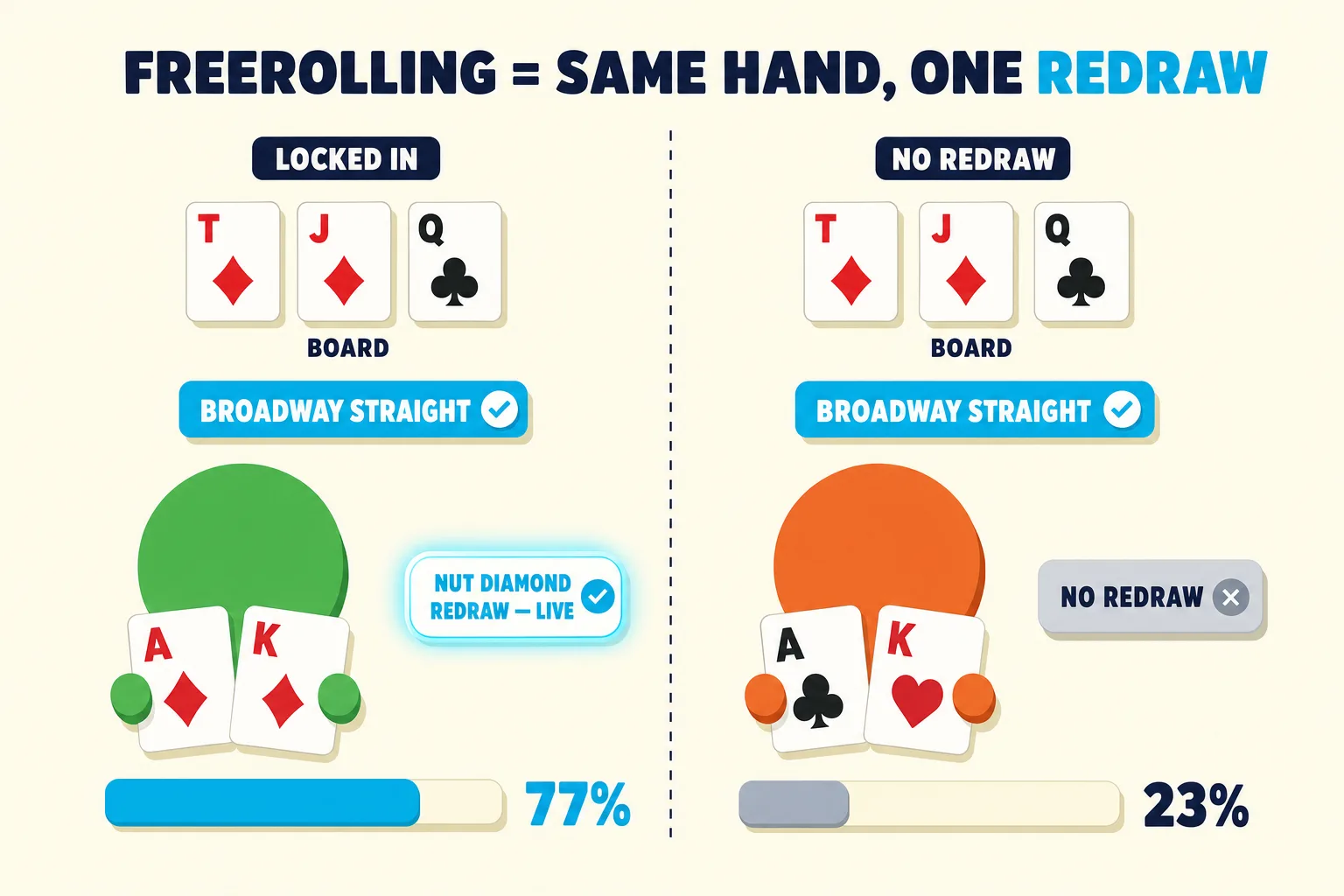
Effective stacks 100 big blinds in a 6-max NLHE cash game. The button opens, the big blind calls. Flop comes T♦ J♦ Q♣ in a single-raised pot.
- Big blind has A♣ K♥ — Broadway straight, no diamonds.
- Button has A♦ K♦ — Broadway straight, plus the nut diamond redraw.
Both players have the nut straight. If the board pairs or runs out blank, they chop the pot. If a fourth diamond comes on the turn or river, the button’s hand climbs to the nut flush and scoops. The all-in equity comes out roughly 23% to the big blind and 77% to the button. The static player will not see that asymmetry from their own cards alone — A-K with the nut straight feels like a stack-off hand, and against most ranges it would be.
The button can play this fast because every chip in the pot is locked-in equity for them. They cannot lose money on a turn or river bet; the worst case is a chop, and a healthy chunk of villain’s range is now drawing dead to the diamond. The big blind is fighting for half a pot at best and stands to lose a full stack at worst. Once a fourth diamond hits and the button bets into the same pot, the right read is that the bet does not need a bluff combo to make sense — the redraw alone covers it.
The same shape comes up on flopped flushes against a higher card of the same suit, on boats with the case quad-out, and on three-card straights that can run out into a higher straight. The pattern is structurally the same: shared made hand now, one player owns the deck on the next streets.
Common mistakes
1) Treating the freerolling player’s bet as a bluff
A bet from the redraw side has no bluff content baked into it. Every chip is risk-free for them, since the worst they can do is chop. Calling station instincts read aggression as a bluff target, but in a freeroll the bet is simply a free poke at the rest of the stack. Do not snap-call or hero-call into bets that only make sense if the bettor has the redraw.
2) Confusing the equity spot with the tournament freeroll
A freeroll tournament is a separate concept, a tournament with no entry fee and a real prize pool. Hand-analysis writing means the equity spot; tournament write-ups mean the format. Conflating them turns into bad searches and worse advice.
3) Failing to lay down the static side when the redraw card lands
The whole point of recognizing a freeroll in real time is to avoid putting in the last big bet on the wrong side of it. If you flopped a shared straight and the second-best version of the suit completes on the turn, a big bet on the dangerous card is exactly what the freerolling hand wants. The hand has not magically gotten weaker, but the hand-vs-hand dynamic has flipped from “tie or lose” to “lose only” once the redraw hits.
4) Forgetting that not every cooler is a freeroll
Two players holding A-K when an ace flops with one of them holding A♦K♦ on a single-diamond board is a cooler dressed up as a freeroll. Both have top pair top kicker, but the diamond doesn’t make the freerolling hand because there isn’t a shared flush on the board to redraw into. Live outs have to lead to an actual higher version of the made hand, not just to a different way of staying ahead. The structural test is whether the redraw improves both hands by the same card or only one.
FAQ
Is freerolling the same as a freeroll tournament?
No. Hand-analysis use (“a freeroll situation”) describes an equity spot in a single hand: two players sharing a made hand, one with live outs. The tournament use (“a freeroll”) describes a format with no entry fee and a real prize pool. The same word covers two unrelated concepts; the surrounding sentence almost always tells you which one is in play.
How is the equity split in a freeroll?
The static player can only tie or lose, so their equity equals their share of the pure-tie outcomes minus zero. The active player owns those same tie outcomes plus the runouts where the redraw lands. In the most common shape — a shared straight with one nut flush redraw — that comes out around 23% to the static side and 77% to the redraw side at all-in equity, depending on dead cards and exact board texture.
Does freerolling come up in PLO and Big O?
Yes, and more often. In split-pot games like Omaha hi-lo and Big O, a freeroll typically means a hand that has already locked the low side of the pot and is also drawing at the high side — guaranteed half, drawing to scoop. The asymmetry is even cleaner there because the locked half is a real number on the felt rather than a tie chance. The NLHE freeroll is the same idea translated to a single-pot game.