


Scoop
A scoop is winning the entire pot in a hi-lo split game by taking both the best high and the best qualifying low. Doubles your share compared to a normal split.
Scoop: winning every dollar of a hi-lo split pot
What “scoop” means
Scoop means winning the entire pot at showdown in a hi-lo split game by holding both the best high hand and the best qualifying low. The pot would normally divide between a high half and a low half, but if one player has the best of both, the dealer never splits it. They push the whole thing in your direction. In Omaha Hi-Lo and Big O, where a pot is most often shared, scooping is the result every serious player is angling for. It is the opposite outcome of getting quartered.
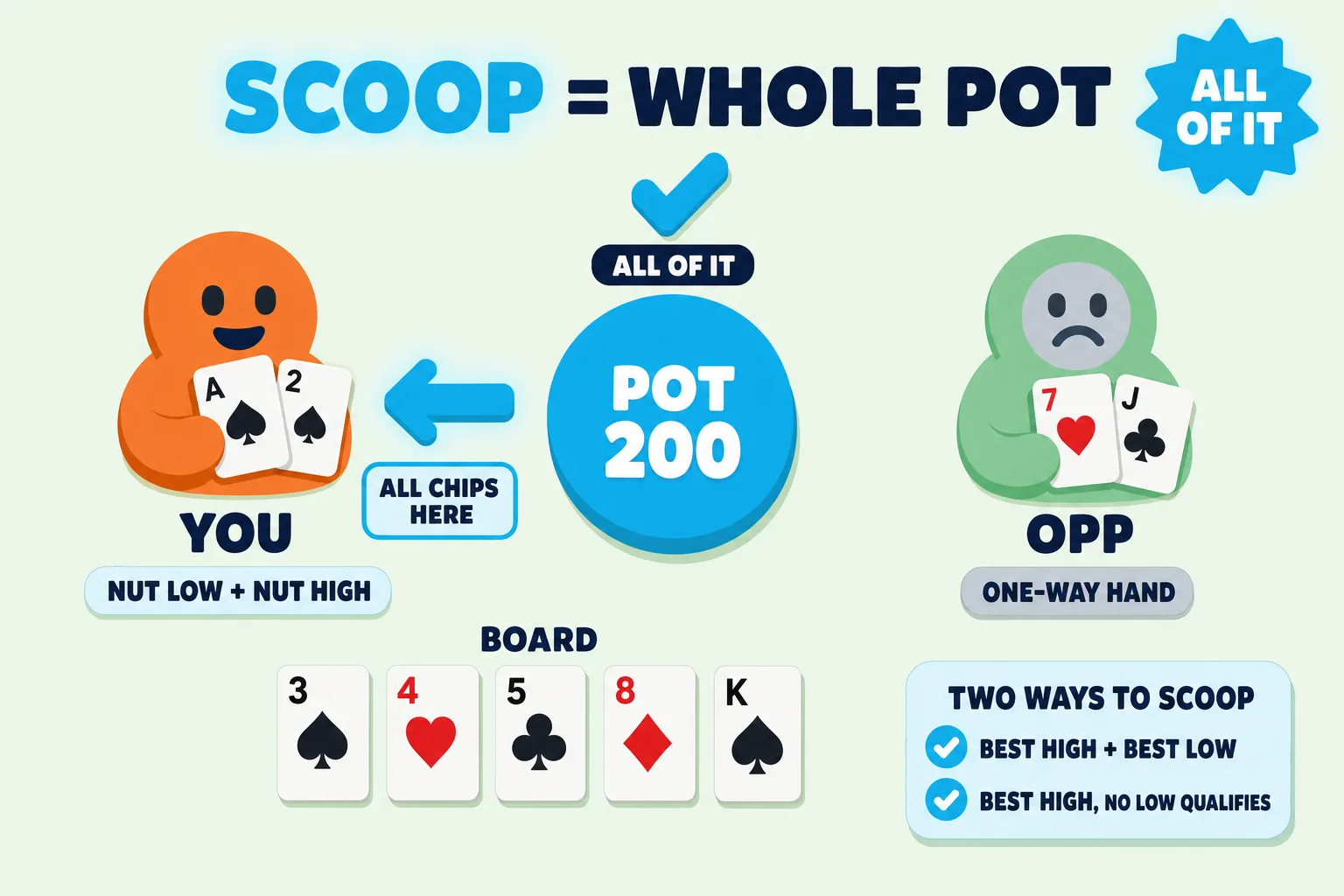
The clean way to keep the nearby words separate:
- Scoop: you win the whole pot. One full unit.
- Split: the pot divides between high and low; you take half.
- Quartered: the side you won is itself tied with another player; you take a quarter.
- Chopped: the table verb for any equal division of a pot, usually a 50/50 split.
If you are at a No-Limit Hold’em table you will hear “scoop” used loosely to mean “took the whole pot.” That is fine slang. The technical, structural meaning lives in hi-lo games, where a pot can actually be divided in the rules and a scoop is therefore a real, named outcome rather than the default.
Related terms
Scoop vs split vs quartered
These four pot-share outcomes appear together in mixed-game commentary and read like synonyms. They are not. The cleanest contrast is “what fraction of the pot did you actually collect.”
| Outcome | Where it shows up | Your share |
|---|---|---|
| Scoop | Hi-lo split games (Omaha 8, Big O, Stud 8); also slang in NLHE | 1 |
| Split pot | Any showdown where the rule divides the pot | 1/2 |
| Quartered | Hi-lo split games when one half is itself tied | 1/4 |
| Three-way chop | Any showdown with three equal best hands | 1/3 |
The simplest mental rule: a hi-lo pot has two halves. A scoop is when one player holds the best of both halves and the dealer never has to divide anything. A normal hi-lo result is one player scoops the high, another scoops the low, and the pot splits 50/50 between them.
When this matters most
Scoops drive the math of hi-lo games more than any other outcome. The reason is simple. If the pot is built up to 100 chips and your reward for winning is half of it, you are paying full bets to get back fifty. To turn a profit on those bets you need to be scooping a meaningful share of the time. The poker books on Omaha 8 are blunt about this: scooping is the goal, not splitting.
A few specific spots where scooping is the lever:
- Wheel hands in Omaha 8 and Big O. A 5-4-3-2-A plays as a five-high straight (a strong high) and the nut low at the same time. When the board cooperates and no one out-flushes you, the wheel scoops outright more often than any other holding.
- Boards with no qualifying low. A flop like K-J-9 makes a low impossible (you need three cards 8 or below on the board for any low to qualify). The high hand wins the entire pot. Players sitting on A-2 hands now have nothing to draw to and are folding for value, which compresses the field and improves your scoop equity if you have the high lead.
- Fold-out scoops. You hold the lead on one side and have a credible threat on the other. A bet on the river that pushes the opposing one-way hand off the pot turns what would have been a split into a scoop. The same chip-stack outcome as a clean two-way win, achieved with one well-timed bet.
- Multiway hi-lo pots. When more players take a flop, the chance that someone else holds the nut low jumps, which means quartering becomes more likely. A hand that scoops in heads-up frequently splits or quarters in a five-way pot. Plan size and aggression around the field, not the strength of your own hand alone.
- NLHE commentary and slang. “She scooped that pot” at a No-Limit table usually just means a single player took it down. There is no low half to fight over. Reading the term in context keeps you from importing hi-lo rules into a high-only game.
When scoops do not matter much: tight short-handed Hold’em sessions where every showdown is high-only, and tournaments where ICM and pay-jumps shape decisions more than chip-share fractions.
Poker Skill teaches only Hold’em, so it has no low half to scoop, and its hand-reading lessons practice the high-only showdown, where one best five-card hand takes the whole pot unless there is a tie.
Example: scooping a multiway Omaha 8 pot
Pot-Limit Omaha 8-or-Better, 6-max cash, 100bb effective stacks, blinds 1/2.
You open the cutoff to 6 with A♠ 2♠ 3♥ K♣, a premium starter. The button calls. The big blind calls. Pot is 19 going to the flop, three players, 94 behind.
Flop: 5♠ 4♠ 7♥. Pot 19.
Read your own hand carefully:
- Low: A-2 plus 5-4-7 on the board makes a 7-low. You need to fade an opponent making a 6-or-better low.
- High: A-2 plus 5-4-7 also makes a wheel-style straight. Your A♠ 2♠ also picks up the nut flush draw.
- Scoop equity: any spade gives you the nut flush plus a still-strong low. A 6 makes your low better and your straight stronger. A 3 makes a 5-low (the nut wheel-low) and the nut straight.
You bet 14, pot. Button calls. Big blind folds. Heads-up to the turn, pot 47.
Turn: 6♠. Pot 47.
This is the dream card. You now hold:
- High: the nut flush (A♠ 2♠ playing both, with 5♠ 4♠ 6♠ on the board).
- Low: A-2-3 plus 4-5-6 on the board makes a wheel, the nut low.
You are freerolling against any non-flush hand and are already locked in for at least the nut low. You bet 35, three-quarter pot. Button calls.
River: J♣. Pot 117. You bet pot. Button calls with A♣ 2♣ 9♥ 10♣, also a nut low.
Showdown:
- High: your A-high flush is the nut high. You win that half outright.
- Low: your 6-4-3-2-A is the nut low. The button’s 6-4-3-2-A is the same hand. You split the low half, so each of you takes a quarter of the pot’s low side, which is one quarter of the whole pot.
You collect 1/2 + 1/4 = 3/4 of the pot. The button collects 1/4. That is not a clean scoop — it is a “three-quarter” result, which Omaha 8 commentary treats as a near-scoop. To have scooped outright you needed your low to be unique (for example, holding A-3 instead of A-2 when the board put up an A-2-x low straight). Hand reading at showdown is where Omaha 8 trips up even experienced players, so practice mapping which two of your four hole cards play for high and which two play for low before the river.
Common mistakes
1) Treating a one-way hand like a scoop hand
Middle-card hands such as 6-7-8-9 in Omaha 8 make a lot of straights but rarely scoop. The boards that complete those straights almost always put up three cards 8 or below, which qualifies a low for someone else. The result is a split, often a quartered split. The fix is to recognize before the flop that a hand without ace-plus-low cards is a one-way hand, and to size your continuation accordingly.
2) Calling down hoping to scoop with no high
Hands like 2-3-4-K with no ace are playable in some games for a multiway flop, but they almost never scoop. They make low-only hands that get split or quartered. Stacking off in a raised pot with no high-side equity is the most common money-losing pattern in Omaha 8. If your hand cannot win a high half on a reasonable runout, you are paying scoop prices for a quarter share.
3) Misreading your own hand at showdown
Omaha 8 hands have to use exactly two hole cards for high and exactly two for low — they do not have to be the same two. Players forget this. They flip what they think is a wheel and discover the best-five-rule leaves them with only a tie for low or a worse high than they thought. Books on the game, including Super System 2, recommend turning your hand face up and asking the dealer to read it if you are unsure. There is no embarrassment in that, and a misread scoop is just a slow-rolled split.
4) Forgetting the field size
A hand that scoops heads-up frequently splits or quarters in a five-way pot. The reason is straightforward: more players means more low cards in play and a higher chance that someone else holds the same nut low. Fold-out scoops also become harder because the price you have to bet to clear extra players on either side keeps climbing. Adjust your continuation aggression to the number of players still in, not the strength of your hand in a vacuum.
FAQ
Does scoop mean the same thing in Hold’em as in Omaha?
Technically no. In Hold’em there is no low half of the pot, so there is nothing to “scoop together” — every standard NLHE pot is a high-only pot won by one player. You will still hear “she scooped that pot” at a Hold’em table, but it is colloquial for “took the whole thing.” The structural meaning of scoop lives in hi-lo split games like Omaha 8, Big O, and Stud 8.
Can you scoop without anyone making a low?
Yes, and it is one of the most common ways scoops happen. If the board does not put up at least three cards 8 or below, no qualifying low exists. The high hand wins the entire pot by default. That is still a scoop in the books’ framing because you took every chip, even though the low side never came into play.
Why do Omaha 8 books say “scooping is the goal”?
Because half-pot results barely cover bets when several players are paying. If the pot is 100 chips and you call for a half-share, you are paying full bets to win 50. To make that math work over a session you need a meaningful share of your wins to be scoops, not splits. The starting hands the books recommend — ace plus low cards plus a kicker that supports a high — are the ones with two-way potential, which is to say scoop potential.