


Equity Bucket
An equity bucket is a study and solver grouping that sorts hands in a range by similar equity and strategic role on a specific board. It is not your win percentage, and it is not the whole range — it's a labelled slice of the range used to simplify what each hand class wants to do.
Practice this in Poker Skill. The flop lessons sort hands the same way, by the job a bet does: top pair on a low board bets for value, the nut flush draw semi-bluffs and a pair of sevens under a king and an ace checks.
Get the free appEquity bucket: a study group of hands that share a role
What an equity bucket is
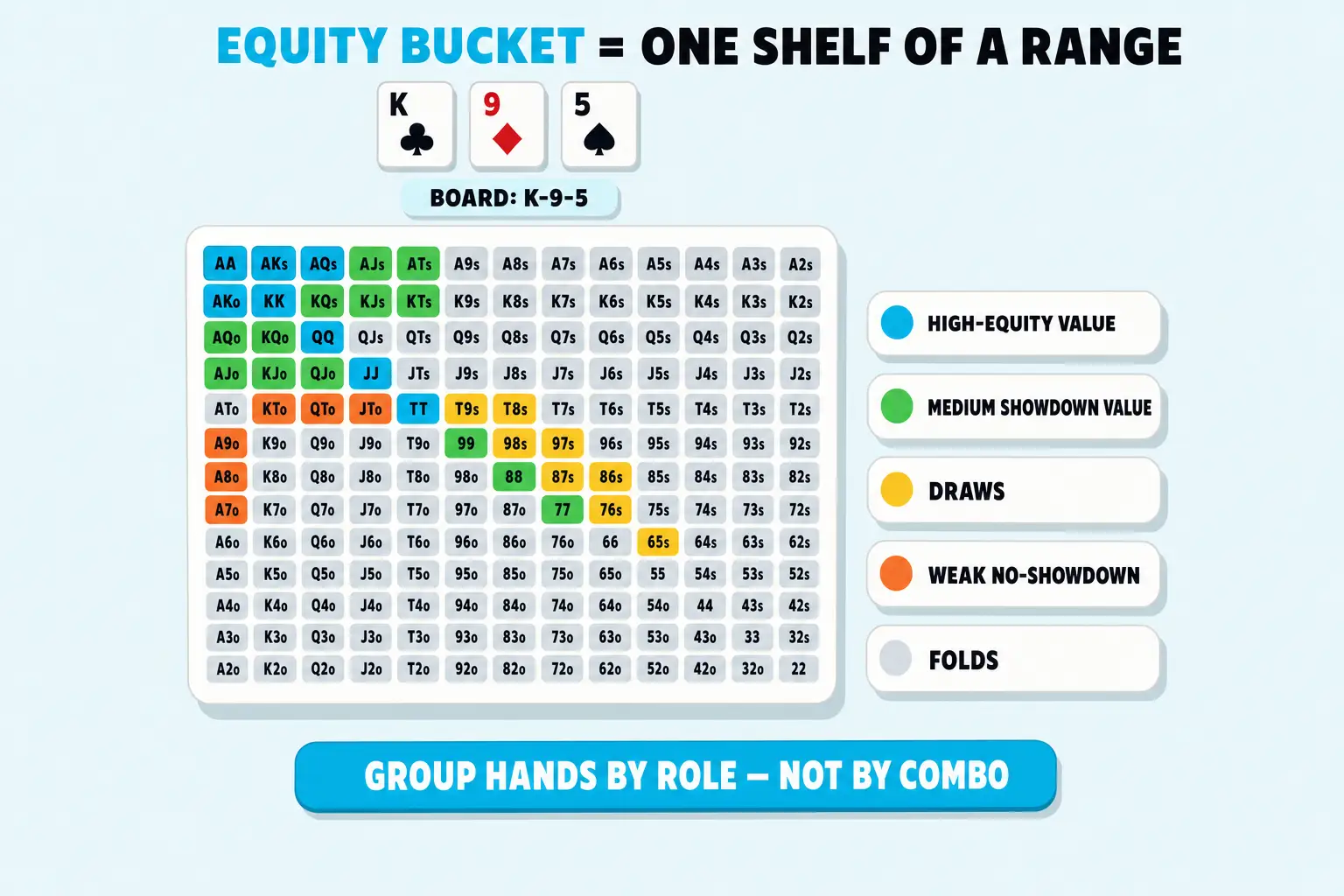
An equity bucket is a slice of a range on a specific board, grouped together because the hands inside it share a similar equity and a similar job. Solvers and study tools use buckets to summarize what hundreds of combos are doing without listing them one by one. A bucket is not your win percentage; it’s a group of hands whose win percentages cluster. A bucket is not the whole range; it’s one shelf of the range.
A useful mental shortcut:
- Equity is a number on one hand: “I have about 42% versus that range.”
- Range is the full set of hands a player can hold: “I defend roughly 35% of starting hands here.”
- Equity bucket is a labelled slice of that set on a board: “The top of my range here is overpairs and top pair, big kicker — that’s my value bucket.”
Related terms
Equity vs range vs equity bucket
These three travel together and get used interchangeably. They are not the same thing.
| Concept | What it is | Example |
|---|---|---|
| Equity | A percentage on a single hand or range vs another | ”K9s has about 50% versus the button’s opening range.” |
| Range | The full set of hands a player can hold in a spot | ”Big blind defends about 35% versus a button 2.5x.” |
| Equity bucket | A labelled slice of a range on a board, grouped by role | ”The ‘medium showdown value’ shelf on K-9-5: middle pairs and weak top pair.” |
A range has the hands. Equity scores any one of them. A bucket is the way studies sort hands inside the range so you can talk about what each shelf wants to do without naming every combo.
The shelves you see most often in solver write-ups and training videos:
- High-equity value. Strong made hands that beat most of the opponent’s continuing range and want to build the pot.
- Medium showdown value. Hands that want to reach a showdown but do not want to bloat the pot. Bluff-catchers live here.
- Draws. Hands that lack showdown value right now but have a credible way to improve. They sit between value and air.
- Weak no-showdown. Hands that will not win at showdown and have no real way to improve, but have some structural reason to bluff (a blocker, an unblock, or a runner-runner draw).
- Folds. Hands that have neither showdown value nor a credible bluff path; they leave the range when continuation is required.
Names vary across tools and authors. The shelves are roughly the same.
Why buckets are useful
A solver outputs a mixed-frequency strategy for every hand in the range, often across several bet sizes. The full grid is unreadable in real time. Buckets compress that into something you can hold in your head and apply at the table.
What buckets do that hand-by-hand reading cannot:
- Make patterns visible. Once you see that the value shelf and the weak no-showdown shelf both bet, while the medium showdown shelf and most draws check, you have learned the structure of the spot. Memorizing each combo will not get you there.
- Translate to the table. A solver does not run mid-hand. What you carry to the felt is a feel for “do I have a value hand, a bluff-catcher, a draw, or a candidate bluff.” Buckets are the bridge between solver output and table thinking.
- Plan a whole range, not just your one hand. When you take an action, you speak for every hand in your range that takes the same action. Buckets let you choose which shelves bet and which check, so the bets and the checks are each balanced.
- Spot leaks fast. “I’m folding too many bluff-catchers on rivers” or “I never bluff with the weak no-showdown shelf” reads as a real leak. “I should fold K7s 23% more often” does not.
The trade-off: buckets are simplifications. Two hands in the same bucket can carry different blockers, different runout coverage, and different equity versus the exact bet size in front of you. The bucket tells you the role; the specific combo can still pull you off the default for a real reason.
Example: button vs big blind on K♣ 9♦ 5♠
You raise the button to 2.5bb at 100bb deep. The big blind calls. The flop comes K♣ 9♦ 5♠ — a dry, broadway-heavy texture where the button has range advantage.
Sort the button’s continuing range into five buckets. The shelves and the example combos are illustrative, not solver output:
- High-equity value. Sets and overpairs: 99, 55, plus AA, KK, QQ, JJ, TT carrying as overpairs, plus AK and KQ for top pair, big kicker. These hands beat most of what the big blind continues with. They want pot building.
- Medium showdown value. Weaker top pair and middle pair with a kicker: KJ, KT, K9-suited, AQ with a backdoor, 88-77 as underpairs. They beat air and worse pairs but lose to sets and overpairs. They want to reach showdown without inflating the pot.
- Draws. Backdoor flush draws and gutshots: T8s, T7s, 76s, 64s, A♣X♣ with a backdoor flush, plus QJ and QT for the gutter. They sit under 50% now but have real outs and bluff potential later.
- Weak no-showdown. Offsuit broadway misses and ace-high without backdoors: AJo, ATo, QJo, J9o-style combos that missed K-9-5 entirely. They block top-of-range hands and have almost no path to a winning showdown.
- Folds. Pure misses with no equity, no blocker, and no draw: small unsuited combos that paid the open and now have nothing on this board.
What buckets make obvious without staring at the grid:
- The high-equity value shelf and a slice of the weak no-showdown shelf bet, often using the same size, so the value-to-bluff ratio at that size stays balanced.
- The medium showdown shelf mostly checks back. Betting it turns a bluff-catcher into a target for a check-raise, which is the wrong job.
- The draws split: enough of them bet to cover the value shelf’s bluff slot, the rest check to realize equity on the turn.
- Picking bluff candidates from the weak no-showdown shelf is what people mean by “bluff with the right combos.” The bucket is the shortlist; blockers and runout coverage decide which combos inside the shortlist actually get the green light.
Same range, same board, far easier to talk about and act on.
Common mistakes
1) Confusing equity with equity bucket
Equity is a percentage on a hand or hand class. A bucket is a labelled group of hands. “I have 42%” is equity. “I’m in the medium showdown shelf” is a bucket. Treat them as different answers to different questions: how often does this hand win, and what is its job inside the strategy.
2) Confusing the bucket with the whole range
Your range on the flop has every continuing combo in it. The medium showdown bucket is one shelf. Treating the bucket as if it were the range — playing every continuing combo as a check-call, for example — collapses the strategy. The value shelf and the bluff candidates still need to bet.
3) Treating bucket boundaries as exact
Buckets are study groupings, not hard categories. A hand can sit on a boundary. KJ on K-9-5 looks like medium showdown value, but if the big blind’s defending range is dense with KQ and KT, that same KJ can play more like a bluff-catcher. The labels are a teaching tool. The exact play is set by the spot, not by which shelf the textbook drew the hand into.
4) Calling the solver’s bucket map a universal answer
The buckets you see in any one solver run depend on the inputs: ranges, sizes, stack depth. Change the input and the bucket boundaries shift. The shape — value, showdown, draws, weak no-showdown, folds — is durable. The exact list of combos in each shelf is conditional on the run.
FAQ
What is the difference between equity and an equity bucket?
Equity is a percentage attached to one hand or one range. An equity bucket is a labelled slice of a range on a specific board, grouped by similar equity and similar role. Equity tells you how often a hand wins. The bucket tells you what job that hand is doing inside a strategy.
How is an equity bucket different from a range?
A range is every hand a player can hold in a spot. An equity bucket is one shelf inside the range, sorted by role on the current board. A range carries the value, showdown, draw, weak no-showdown, and fold shelves all together; a bucket is just one of those shelves.
How many equity buckets are there?
Most studies use four or five labelled shelves: high-equity value, medium showdown value, draws, weak no-showdown, and folds. The exact count varies. Some authors collapse weak no-showdown into folds; some split the value shelf into “premium” and “good top pair.” The shapes are durable; the names and counts are not.
Do equity buckets change between streets?
Yes. The flop bucket a hand sits in is not where it lives forever. A turn card can promote a draw into the value shelf, demote a top pair into the medium showdown shelf, or move a weak no-showdown combo into pure folds when the equity dries up. Reread the buckets every street.